Categories
Resources

Occupying Political Science: The Occupy Wall Street Movement from New York to the World

By Emily Welty (Editor), Matthew Bolton (Editor), Meghana Nayak (Editor), Christopher Malone (Editor)

Occupying Political Science is a collection of critical essays by New York based scholars, researchers, and activists, which takes an unconventional look at the Occupy Wall Street movement through concepts found in the field of political science. Both normative and descriptive in its approach, Occupying Political Science seeks to understand not only the origins, logic, and prospects of the OWS movement, but also its effect on political institutions, activism, and the very way we analyze power.

https://www.palgrave.com/us/book/9781137277398

Categories
Resources

Citizenship: Paul on Peace and Politics

By Gordon Zerbe

In this stimulating collection of essays, Zerbe offers “a revisiting of Paul’s theological vision and practical activism around the theme of citizenship." The chapters in the book are organized according to the citizenship themes of loyalty, mutuality, and security. Essays in the first section, "loyalty," draw attention to the fundamental personal and corporate dynamics of citizenship in the context of Paul's ecclesial politics. The second section, "mutuality," is centred mainly on the internal features of the Messianic assembly as a citizen community, including its approach to social diversity and economic disparity. The third section, "security," includes essays that investigate the questions of violence, peace, and warfare in and pertaining to Paul's writings. A last section, "affinities," engages Paul's perspective with broader conversation partners beyond the fields of biblical and theological studies.

https://www.commonword.ca/ResourceView/2/15099

Categories
Resources

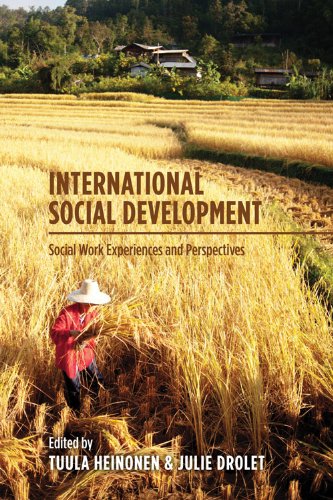
International Social Development: Canadian Social Work Experiences and Perspectives

By Tuula Heinonen (Editor), Julie Drolet (Editor)

With a chapter by Ray Vander Zaag

This edited collection offers a range of the current theoretical concepts and perspectives that shape international social development today. Utilizing examples from actual social workers in regions such as Asia, Eastern Europe and Latin America, International Social Development brings together scholars who are engaged internationally in social development work aimed at addressing poverty, gender inequality, sustainable livelihoods and food security. The first of its kind in Canada, International Social Development will assist students in building critical knowledge, learning methods to mitigate post-colonial attitudes and developing practical skills essential to doing social work in an increasingly interconnected and globalized world. With greater populations across the globe becoming increasingly vulnerable to the effects of poverty, environmental degradation, globalization and urbanization, the need for social work professionals to adopt practices that address such complex social issues is dire.

With this need in mind, the early chapters of the book conceptualize and discuss the general objectives and various models of international social development, with particular attention paid to Canadian aid organizations and the concept of gender in international social research and practice. Subsequent chapters highlight specific international social work projects from around the globe, dealing with discriminatory practices in tsunami-affected South India, food security in Brazil and gender equality in rural China, making this book a well-rounded introduction for students unfamiliar with international social development and a primer on pressing issues for social work professionals already working in the field.

https://www.amazon.ca/International-Social-Development-Experiences-Perspectives/dp/1552665240/

Categories
Resources

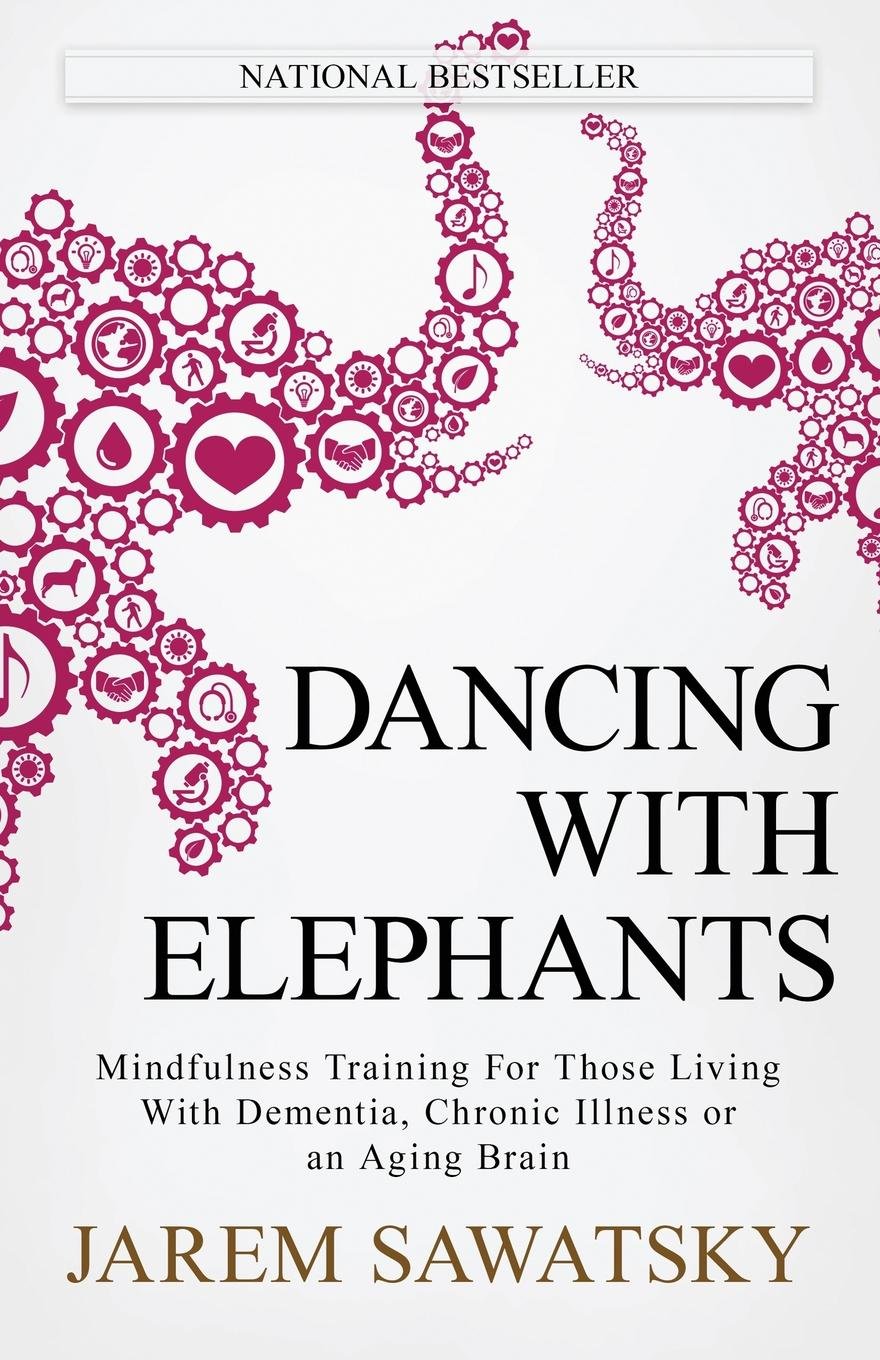
Dancing with Elephants: Mindfulness Training For Those Living With Dementia, Chronic Illness or an Aging Brain

By Jarem Sawatsky

Want to enjoy the life you are living, even as you face major life challenges? Is your mind succumbing to age? Is your body failing you? Can you ever find joy, peace, or fulfillment in these challenging conditions? The answer is a resounding YES.
Jarem Sawatsky saw the countless guides out there for those caring for the ill and healing the curable, but when he was diagnosed with Huntington's Disease he found there was nothing for those living with incurable illness. He quit his job as a professor and devoted his life to exploring the possibilities of living with chronic conditions. Now he's bringing his findings and insights to you.

In Dancing With Elephants you'll discover:

  • Simple practices to bring healing to your heart and life to your new outlook
  • Humorous (and occasionally heart-wrenching) stories of Sawatsky's own journey
  • Multiple ways to build confidence in yourself, even when you've been shaken to the core
  • A new perspective to transform your pain and renew your spirit
  • Practical tools to face your seemingly inescapable fears, and much, much more!

Based on the popular blog of the same name, Dancing With Elephants includes insightful interviews with chronic disease experts Jon Kabat-Zinn, Lucy Kalanithi, and Patch Adams. Sawatsky's landmark book provides support that only a fellow traveler down this road can offer.

https://www.amazon.com/Dancing-Elephants-Mindfulness-Training-Dementia/dp/0995324204

Categories
Resources

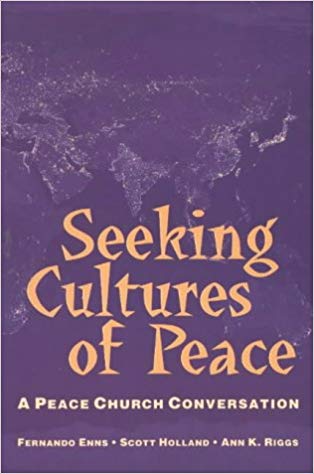
Seeking Cultures of Peace: A Peace Church Conversation

By Fernando Enns (Editor), Scott Holland (Editor), and Ann Riggs (Editor)

The essays in this book represent a contribution of the Historic Peace Churches (HPC) to the work of the World Council of Churches' Decade to Overcome Violence. They are divided into four sections: the first introduces the ecumenical context of this discussion, the history of HPC relations, and the globalized reality in which contemporary violence occurs. The second is written from three geo-social settings and engages the notion of globalization from three viewpoints: biblical studies, theological ethics and historiography. The third section engages the gospel and our traditions within the contexts of HPC communities in North America, Nigeria and Colombia. And the fourth discusses resources in HPC tradition for action, reflection and critique in building a future of justice and peace. An appendix reproduces a statement prepared at a 2001 consultation of interested members of the Brethren, Quaker and Mennonite communities, entitled Just Peace-making: Towards an Ecumenical Ethical Approach from the Perspective of the Historic Peace Churches. A Study Paper for Dialogue with the Wider Church.

https://www.amazon.com/Seeking-Cultures-Peace-Church-Conversation/dp/2825414026

Categories
Resources

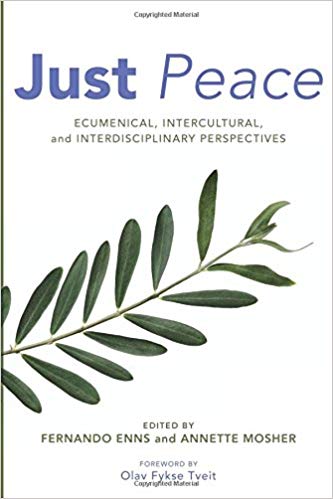
Just Peace: Ecumenical, Intercultural, and Interdisciplinary Perspectives

By Fernando Enns (Editor) and Annette Mosher (Editor)

Christian theology and ethics have wrestled with the challenge to apply Jesus's central message of nonviolence to the injustices of this world. Is it not right to defend the persecuted by using violence? Is it unjust if the oppressed defend themselves-if necessary by the use of violence-in order to liberate themselves and to create a more just society? Can we leave the doctrine of the just war behind and shift all our attention toward the way of a just peace? In 2011 the World Council of Churches brought to a close the Decade to Overcome Violence, to which the churches committed themselves at the beginning of the century. Just peace has evolved as the new ecumenical paradigm for contemporary Christian ethics. Just peace signals a realistic vision of holistic peace, with justice, which in the concept of shalom is central in the Hebrew Bible as well as in the gospel message of the New Testament. This paradigm needs further elaboration. VU University gathered peacebuilding practitioners and experts from different parts of the world (Africa, Latin America, North America, Asia, and Europe) and from different disciplines (anthropology, psychology, social sciences, law, and theology)-voices from across generations and Christian traditions-to promote discussion about the different dimensions of building peace with justice.

https://www.amazon.com/Just-Peace-Intercultural-Interdisciplinary-Perspectives/dp/1620323621

Categories
Resources

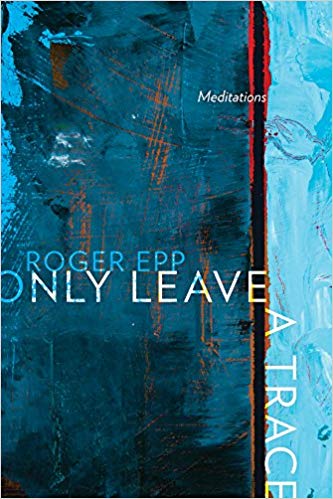
Only Leave a Trace: Meditations

By Roger Epp

Roger Epp's poetic meditations about the minor miracles, the difficulties, and the loneliness of leading a small university campus through a time of significant change are depicted in a series of elegant yet understated prose pieces, illustrated by his life partner, Rhonda Harder Epp. Taking a candid look at the many challenges such a position brings, Roger Epp humanizes, scrutinizes, and upholds the integrity of academic administrative work. Only Leave a Trace will appeal to those who work in universities, hold leadership roles in them, or care about the connections between higher education, students, and place.

https://www.amazon.com/Only-Leave-Trace-Roger-Epp/dp/1772122661

Categories
Resources

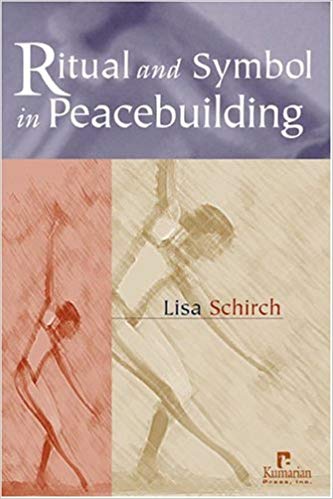
Ritual and Symbol in Peacebuilding

By Lisa Schirch

Conflict is dramatic. In theater, literature, story telling, and news reporting, it is a powerful mechanism that draws attention, heightens the senses and evokes emotion. Schirch argues that peacebuilding has the potential to do just the same.

Examples of peacebuilding often center on the serious, rational negotiations and formal problem-solving efforts in conflict situations. Schirch argues, though, that what truly bonds adversaries and helps achieve peace are the symbolic, non-verbal ritual acts–shaking hands, sharing a meal, showing a photograph of a loved one. Yet these are often overlooked as deliberate components of peace negotiations.

Ritual and Symbol in Peacebuilding underscores the importance of incorporating symbolic tools, including ritual, into traditional approaches to conflict. Ritual assists in solving complex, deep-rooted conflicts, and helps to confirm and transform worldviews, identities, and relationships. With theories and language to explain the symbolic dimensions of conflict, this text will be useful to scholars and practitioners active in the diverse field of peacebuilding.

https://www.amazon.com/Ritual-Symbol-Peacebuilding-Lisa-Schirch/dp/1565491947/

Categories
Resources

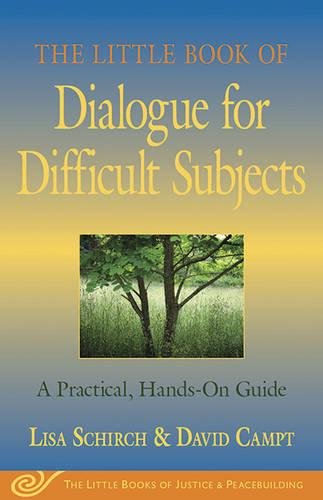
The Little Book of Dialogue for Difficult Subjects: A Practical, Hands-On Guide

By Lisa Schirch and David Campt

The word "dialogue" suffers from over-use, yet its practice is as transforming and as freshly hopeful as ever.

Authors Schirch and Campt demonstrate dialogue's life and possibilities in this clear and absorbing manual: "Dialogue allows people in conflict to listen to each other, affirm their common ground, and explore their differences in a safe environment."

The Little Book is a to-the-point handbook, covering:

  • "Dialogue vs. Debate"
  • "When to use dialogue"
  • "Key dialogue facilitation skills"
  • "Inviting people to a dialogue process"
  • "Moving from dialogue to action"
  • "Assessing the effectiveness of dialogue"

Schirch has worked throughout the Southern hemisphere in peacebuilding projects. Campt has focused on racial and class reconciliation in American cities. Many of the skills and the case studies they offer in this book come from their own wide experiences.

https://www.amazon.com/Little-Dialogue-Difficult-Subjects-Hands/dp/1561485519

Categories
News Resources

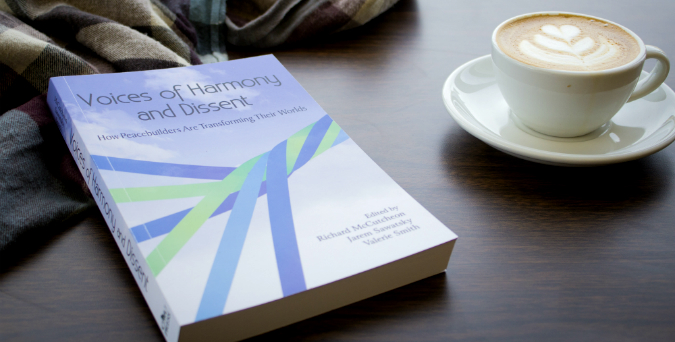
Download your free copy of Voices of Harmony and Dissent

Last June we launched our book, Voices of Harmony and Dissent: How Peacebuilders are Transforming Their Worlds.  Each chapter, authored by a different CSOP instructor, explores three dimensions of peacebuilding:

  • stories of inspiring peace work
  • tools and strategies for peacebuilding in a variety of settings
  • resources that have helped shape the author's views

Now we are making the e-book version of this book available for free.  We think this book captures the spirit of the CSOP and we hope that it will give you a taste of what the CSOP has to offer, particularly for those of you who are unable to join us for one of our five-day courses. 

You can download your free copy of this book at at CommonWord, Amazon, Kobo, Nook, or Apple. If you wish to purchase a print version of the book, you can do that on any of the above sites or through the CSOP website. We hope you will enjoy reading this book and that it will equip and inspire you in your work as a peacebuilder.

Please feel free to let your friends, communities and social media networks know about this free offer.  

What others have said about Voices of Harmony & Dissent:

“This book is an empowering patchwork of rich voices of harmony and dissent… It is a book you can dip into here and there on a plane or before bed. This is because it is a compilation that lets the journey be your own in connecting up the many strands of wisdom it contains. All of us can be much better peacebuilders if we take that journey of the connections with this sumptuous volume.”

– John Braithwaite, author of Crime, Shame and Reintegration

"This book stands out because it reflects and charts the creativity, energy and relevance of the field for global peacemaking. ”

– Tom Woodhouse, author Contemporary Conflict Resolution 

"This is a book of wisdom… Even the experience of reading these essays can prompt a greater peace .”

– John Borrows Canada Research Chair in Indigenous Law at the University of Victoria Law School

"These stories and essays intimately and powerfully convey two fundamental truths. The first is that history changes only through the actions of people who decide it has to change… The second truth is that the human spirit is worth struggling for, day after day, year after year, no matter whether we are successful or not. In this work, which joins us at the heart, we will always find joy, even in the harshest of external circumstances."

– Margaret J. Wheatley, bestselling author Leadership and the New Science

"Voices of Harmony and Dissent holds the heart of how social change happens–people who believe deeply, develop significant relationships, and have the courage to engage together. Each and every chapter provides lessons and inspiration and, most importantly, has a deep resonance that rises from these voices of hard-won experience and reflective practice, an authenticity that touches the reader and points us toward the kind of learning that really makes a difference in our world."

– John Paul Lederach, author The Moral Imagination