Categories
News Resources

Diverse new CSOP book explores peacebuilding around the world

June 10, 2015

CMU to host launch of ‘Voices of Harmony & Dissent’ on Tuesday, June 16

A new book arising from Canadian Mennonite University’s (CMU) Canadian School of Peacebuilding (CSOP) explores the stories, theory, and tools of 16 peace leaders, trainers, and activists from around the world.

Voices of Harmony & Dissent: How Peacebuilders are Changing Their Worlds was edited by Richard McCutcheon, Jarem Sawatsky, and Valerie Smith. The editors will celebrate the release of the book with a launch event happening Tuesday, June 16 at 7:00 PM in the Great Hall at CMU (500 Shaftesbury Blvd.). The event is free, and all are welcome to attend.

Offering an intriguing mix of styles and perspectives, the peacebuilders included in the book describe how they have used their creativity, compassion, and frustrations to learn how to peacefully engage and transform the world around them.

Each contributor has taught at the CSOP, which offers a selection of five-day courses each June.

Smith, co-director of the CSOP, says the book arose out of a desire to expose people to the amazing instructors who teach at the school.

“We have so many people who are interested in the CSOP, and so many who apply but don’t get a chance to come here for all sorts of reasons, like finances and visas,” Smith says. “We wanted to find a way to serve those people who can’t be here in person.”

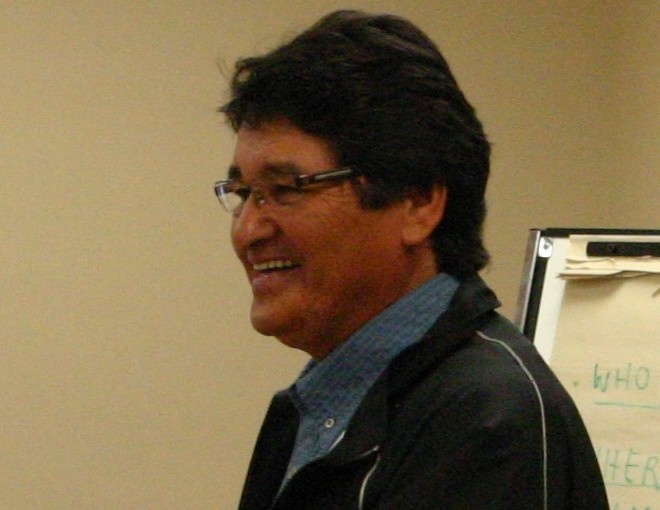
Published by CMU Press, Voices of Harmony & Dissent includes contributions from Ovide Mercredi, former National Chief of the Assembly of First Nations; Mubarak Awad, a Palestinian-American psychologist; Ouyporn Khuankaew, a Buddhist feminist activist from Thailand; Martin Entz, a professor in the Department of Plant Science at the University of Manitoba; Karen Ridd, Instructor in Peace and Conflict Resolution Studies at CMU; and more.

Through inspiring stories, the book takes readers on a journey of interrelated themes including women and peacebuilding, nonviolent action for social change, restorative justice, indigenous approaches to change, spirituality and creative arts, circle process, food security, mediation, intercultural peacebuilding, and truth and reconciliation.

While the style and topics of the essays are radically diverse, Smith says there are common themes that tie the collection together.

“All of the essays are written by deeply committed, experienced peacebuilders who are living what they teach,” she says.

Smith adds that she is looking forward to the book launch.

“In reading through these essays over and over again, I feel like I’ve learned a little bit about each contributor and what they have offered in their classes at the Canadian School of Peacebuilding,” she says. “That feels like a real gift. I’m excited to share that with the community and hear people’s feedback as they begin to read the book.”

Established in 2009, the CSOP is a learning community of diverse peacebuilders from all faiths, countries, and identity groups who come together to learn, network, and engage in peacebuilding.

Now in its seventh year, the 2015 CSOP courses will take place June 15-19 and June 22-26.
Categories
News Profiles

CSOP Participant Profile – John Fox

by Aaron Epp

Criminal, prosecutor reunite at Canadian School of Peacebuilding

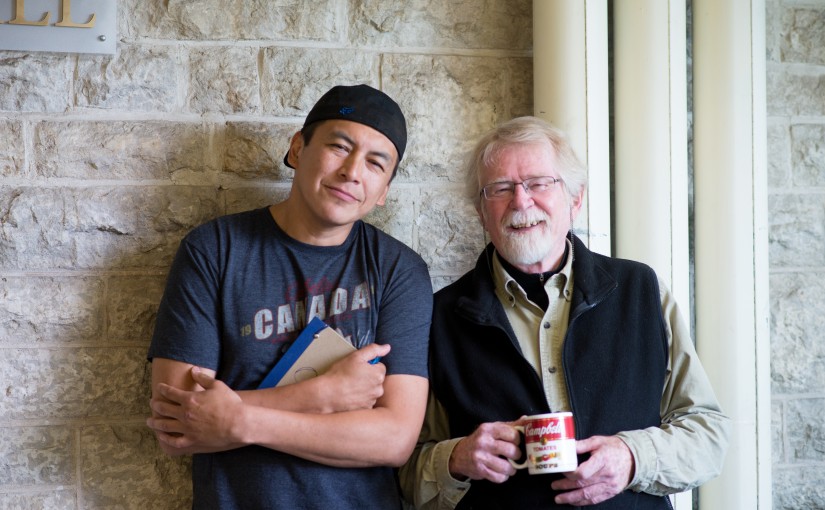
John Fox and Rupert Ross are used to seeing each other in the courtroom, not the classroom.

When Ross worked as the Assistant Crown Attorney for the District of Kenora, Fox encountered him during numerous bail hearings after being arrested for a variety of crimes, including assault and weapons charges.

“He was the enemy,” says Fox, 43. “It was always us against them.”

The two reunited at the 2014 Canadian School of Peacebuilding (CSOP), this time on friendlier terms: Fox enrolled in Exploring Indigenous Justice and Healing, a course taught by Ross.

Between 1992 and 1995, Ross was seconded to the federal Aboriginal Justice Directorate. He travelled across Canada, examining Aboriginal approaches to justice with special emphasis on healing programs for victims, offenders, families, and communities.

He wrote two books as a result: Dancing with a Ghost: Exploring Indian Reality and Return to the Teachings: Exploring Aboriginal Justice.

Fox discovered the books as a student at Menno Simons College (MSC).

“I loved his books,” Fox said, adding that reading them gave him a better understanding of his Aboriginal heritage, the gap in communication between Aboriginal peoples and the dominant white Canadian society, and the history of violence in his family.

“I was hurt a lot as a child,” Fox said. “Because of that hurt, if you don’t deal with it properly, you tend to hurt other people.”

Fox grew up in Big Trout Lake First Nation, a fly-in community in northwestern Ontario. From the age of 11 to 15, he was sexually abused. He lost two close friends to suicide as a teenager, and turned to drugs and alcohol to deal with the pain.

Until a few years ago, he had spent most of his life working as a drug dealer. Fox was a violent person whose run-ins with the law led to nine or 10 stints in jail.

In 2008, his then-girlfriend’s sister committed suicide in front of him. Blaming Fox, the woman’s brother and boyfriend burned down his house.

After the suicide, things began to change for Fox. He stopped dealing drugs and started attending Alcoholics Anonymous. He began volunteering at a church drop-in centre and embarked on a healing journey that has relied heavily on traditional Aboriginal practices.

Today, Fox has been sober for four years and he is happily married.

Reuniting with Ross at the CSOP was a pleasure for Fox, and an indication of how far he has come.

“He’s such a storyteller,” Fox said of Ross. “He reminds me of an elder. Ask him a question and he doesn’t answer, he tells you a story.”

Fox may be enrolled in Conflict Resolution classes at MSC, but he says that what he’s really studying is the man he sees when he looks in the mirror.

“I’m studying myself, because I was a person with so much conflict.”


Categories
Resources

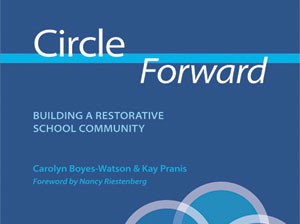
Circle Forward: Building a Restorative School Community

By Carolyn Boyes-Watson and Kay Pranis

Circle Forward is a resource guide designed to help teachers, administrators, students and parents incorporate the practice of Circles into the everyday life of the school community.  This resource guide offers comprehensive step–by-step instructions for how to plan, facilitate and implement the Circle for a variety of purposes within the school environment.  It describes the basic process, essential elements and a step-by-step guide for how to organize, plan, and lead Circles. It also provides over one hundred specific lesson plans and ideas for the application of Circles in the following areas of school life:

•    Learning and establishing a Circle practice
•    Establishing and affirming community norms
•    Teaching and learning in Circle
•    Building connection and community
•    Promoting social-emotional skills
•    Facilitating important but difficult conversations
•    Working together as adults
•    Engaging parents and the wider community
•    Developing students as leaders in peer Circles
•    Using Circles for restorative discipline

http://www.livingjusticepress.org/index.asp?Type=PRODLIST&SEC={9643748B-1735-4115-A479-FA6F18327BAD}&DE={3D3F9629-546F-4123-B857-DFC2E8D97820}

Categories
Resources

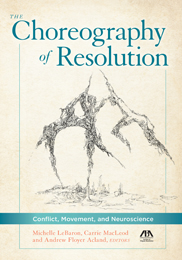
The Choreography of Resolution: Conflict, Movement, and Neuroscience

The Choreography of Resolution: Conflict, Movement, and Neuroscience

Edited by Michelle LeBaron (Instructor – CSOP 2011), Carrie MacLeod, Andrew Floyer Acland

The Choreography of Resolution will revolutionize how mediators handle conflict resolution. Learning how neuroscience is proving what dancers have known for centuries – this book explores the links between the physical, mental, and psychological factors that affect conflict. Examining the autobiographical and practice experiences with diverse cultural, historical and social realities highlights both challenges and breakthroughs in this burgeoning area. Comprehensive in review, this ground-breaking book investigates:

– the role of movement in conflict dynamics
– exposes the limitations of omitting the body from the understandings of conflict
– explores the ethical dimensions of embodied approaches
– proposes key strategies for conflict intervention

Come take the journey through the body as the authors examine how a closed body leads to a closed mind and how movement and dance can positively alter conflict resolution.

http://apps.americanbar.org/abastore/index.cfm?pid=5100023&section=main&fm=Product.AddToCart

Categories
Resources

The Hidden Door: Mindful Sufficiency as an Alternative to Extinction

The Hidden Door: Mindful Sufficiency as an Alternative to Extinction

By Mark Burch (Instructor – CSOP 2011)

Many people sense that consumer culture is dragging us toward extinction.  We feel trapped in a cell of our own making. If humanity is to have any sort of future worth living in, we must discover an exit from our confinement. There is a door, hidden in plain sight.

What sort of culture might appear if we took seriously the essential values and principles that form the deep structure of voluntary simplicity and used them to inform a new perspective of the good life? Might we discover an exit from the confining cell of consumer culture? Can we find the passage leading beyond individual lifestyle choice to cultural renaissance? This book aims to help seed this renaissance by widening the conversation about how we transition from the road to extinction to a path with heart that has a future.

https://www.createspace.com/4477285

Categories
Media Video

CSOP Participant Reflections

If you want to know more about the CSOP and what the CSOP experience offers, take a few minutes to watch this video of reflections from 2013 CSOP participants and instructors.

Categories
News

Ovide Mercredi awarded University of Manitoba 2013 Distinguished Alumni Award

Ovide Mercredi, CSOP instructor in 2010 and 2012, was recently awarded the 2013 Distinguished Alumni Award by the University of Manitoba’s Alumni Association.    See http://umanitoba.ca/news/blogs/blog/2013/04/26/ovide-mercredi-annouced-as-2013-distinguished-alumni-recipient/ to read more about it.

Categories
News

Armand Volkas, 2013 CSOP instructor, returns to Winnipeg to teach an Expressive Arts Worskshop

Armand Volkas, who taught at the CSOP in 2013, will be returning to Winnipeg in January, 2014.  Along with Laura Simms and Kate Donahue, Armand will be offering creative arts workshops as part of a certificate program offered by Express Yourself: Art Therapy & Expressive Arts Workshops for Children, Youth & Adults in Winnipeg.  For more information go to http://www.breathe-create-transform.ca/ or contact express-yourself@shaw.ca.

Categories
Audio Media

Peacebuilder Banquet – George Lakey and the story of The Lion Tamer

Click    to listen to the story of The Lion Tamer, as told by George Lakey at the CSOP Peacebuilders Banquet, June 23, 2011.

Each week during the Canadian School of Peacebuilding we invite the general public to join our students for a lunch banquet of great local food and storytelling by one of the week’s instructors on the the theme of great peacebuilders.  This is a time to gather as a community of peacebuilders, to celebrate with great food and to be inspired by the stories of peacebuilders from around the world.


Categories
Audio Media

Peacebuilder Banquet – Stan McKay and the story of Florence

Click    to listen to the story of Florence, as told by Stan McKay at the CSOP Peacebuilders Banquet, June 9, 2011.

Each week during the Canadian School of Peacebuilding we invite the general public to join our students for a lunch banquet of great local food and storytelling by one of the week’s instructors on the the theme of great peacebuilders.  This is a time to gather as a community of peacebuilders, to celebrate with great food and to be inspired by the stories of peacebuilders from around the world.