Categories
Resources

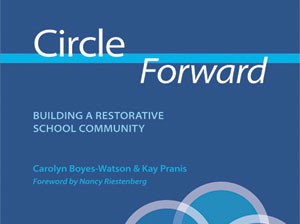
Circle Forward: Building a Restorative School Community

By Carolyn Boyes-Watson and Kay Pranis

Circle Forward is a resource guide designed to help teachers, administrators, students and parents incorporate the practice of Circles into the everyday life of the school community.  This resource guide offers comprehensive step–by-step instructions for how to plan, facilitate and implement the Circle for a variety of purposes within the school environment.  It describes the basic process, essential elements and a step-by-step guide for how to organize, plan, and lead Circles. It also provides over one hundred specific lesson plans and ideas for the application of Circles in the following areas of school life:

•    Learning and establishing a Circle practice
•    Establishing and affirming community norms
•    Teaching and learning in Circle
•    Building connection and community
•    Promoting social-emotional skills
•    Facilitating important but difficult conversations
•    Working together as adults
•    Engaging parents and the wider community
•    Developing students as leaders in peer Circles
•    Using Circles for restorative discipline
http://www.livingjusticepress.org/index.asp?Type=PRODLIST&SEC={9643748B-1735-4115-A479-FA6F18327BAD}&DE={3D3F9629-546F-4123-B857-DFC2E8D97820}

Categories
Resources

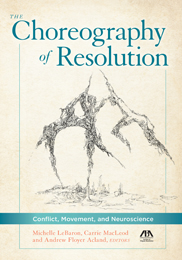
The Choreography of Resolution: Conflict, Movement, and Neuroscience

The Choreography of Resolution: Conflict, Movement, and Neuroscience

Edited by Michelle LeBaron (Instructor – CSOP 2011), Carrie MacLeod, Andrew Floyer Acland

The Choreography of Resolution will revolutionize how mediators handle conflict resolution. Learning how neuroscience is proving what dancers have known for centuries – this book explores the links between the physical, mental, and psychological factors that affect conflict. Examining the autobiographical and practice experiences with diverse cultural, historical and social realities highlights both challenges and breakthroughs in this burgeoning area. Comprehensive in review, this ground-breaking book investigates:

– the role of movement in conflict dynamics
– exposes the limitations of omitting the body from the understandings of conflict
– explores the ethical dimensions of embodied approaches
– proposes key strategies for conflict intervention

Come take the journey through the body as the authors examine how a closed body leads to a closed mind and how movement and dance can positively alter conflict resolution.

http://apps.americanbar.org/abastore/index.cfm?pid=5100023&section=main&fm=Product.AddToCart

Categories
Resources

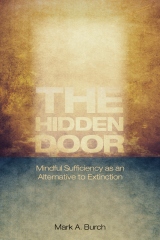
The Hidden Door: Mindful Sufficiency as an Alternative to Extinction

The Hidden Door: Mindful Sufficiency as an Alternative to Extinction

By Mark Burch (Instructor – CSOP 2011)

Many people sense that consumer culture is dragging us toward extinction.  We feel trapped in a cell of our own making. If humanity is to have any sort of future worth living in, we must discover an exit from our confinement. There is a door, hidden in plain sight.

What sort of culture might appear if we took seriously the essential values and principles that form the deep structure of voluntary simplicity and used them to inform a new perspective of the good life? Might we discover an exit from the confining cell of consumer culture? Can we find the passage leading beyond individual lifestyle choice to cultural renaissance? This book aims to help seed this renaissance by widening the conversation about how we transition from the road to extinction to a path with heart that has a future.

https://www.createspace.com/4477285

Categories
Audio Media

Peacebuilder Banquet – George Lakey and the story of The Lion Tamer

Click    to listen to the story of The Lion Tamer, as told by George Lakey at the CSOP Peacebuilders Banquet, June 23, 2011.

Each week during the Canadian School of Peacebuilding we invite the general public to join our students for a lunch banquet of great local food and storytelling by one of the week’s instructors on the the theme of great peacebuilders.  This is a time to gather as a community of peacebuilders, to celebrate with great food and to be inspired by the stories of peacebuilders from around the world.


Categories
Audio Media

Peacebuilder Banquet – Stan McKay and the story of Florence

Click    to listen to the story of Florence, as told by Stan McKay at the CSOP Peacebuilders Banquet, June 9, 2011.

Each week during the Canadian School of Peacebuilding we invite the general public to join our students for a lunch banquet of great local food and storytelling by one of the week’s instructors on the the theme of great peacebuilders.  This is a time to gather as a community of peacebuilders, to celebrate with great food and to be inspired by the stories of peacebuilders from around the world.


Categories
Audio Media

Peacebuilder Banquet – George Lakey and the story of Barbara Smith

Click    to listen to the story of Barbara Smith, as told by George Lakey at the CSOP Peacebuilders Banquet, June 23, 2011.

Each week during the Canadian School of Peacebuilding we invite the general public to join our students for a lunch banquet of great local food and storytelling by one of the week’s instructors on the the theme of great peacebuilders.  This is a time to gather as a community of peacebuilders, to celebrate with great food and to be inspired by the stories of peacebuilders from around the world.


Categories
Resources

Global Nonviolent Action Database (GNAD)

Go to http://NVDatabase.swarthmore.edu to access a free global database of nonviolent actions.  Campaigns are drawn from nearly every country in the world, in which people overthrew dictators, changed environmental policies, halted racist discrimination, fought for economic justice, established their religious freedom, changed sexist and other oppressive laws, established national independence, and defended their neighborhoods – all by using nonviolent resistance.  Included are cases in which the campaign failed so that learning can be gained from these cases.

The database was envisioned and is managed by George Lakey, activist, professor and CSOP 2011 Instructor.