Categories
News Profiles

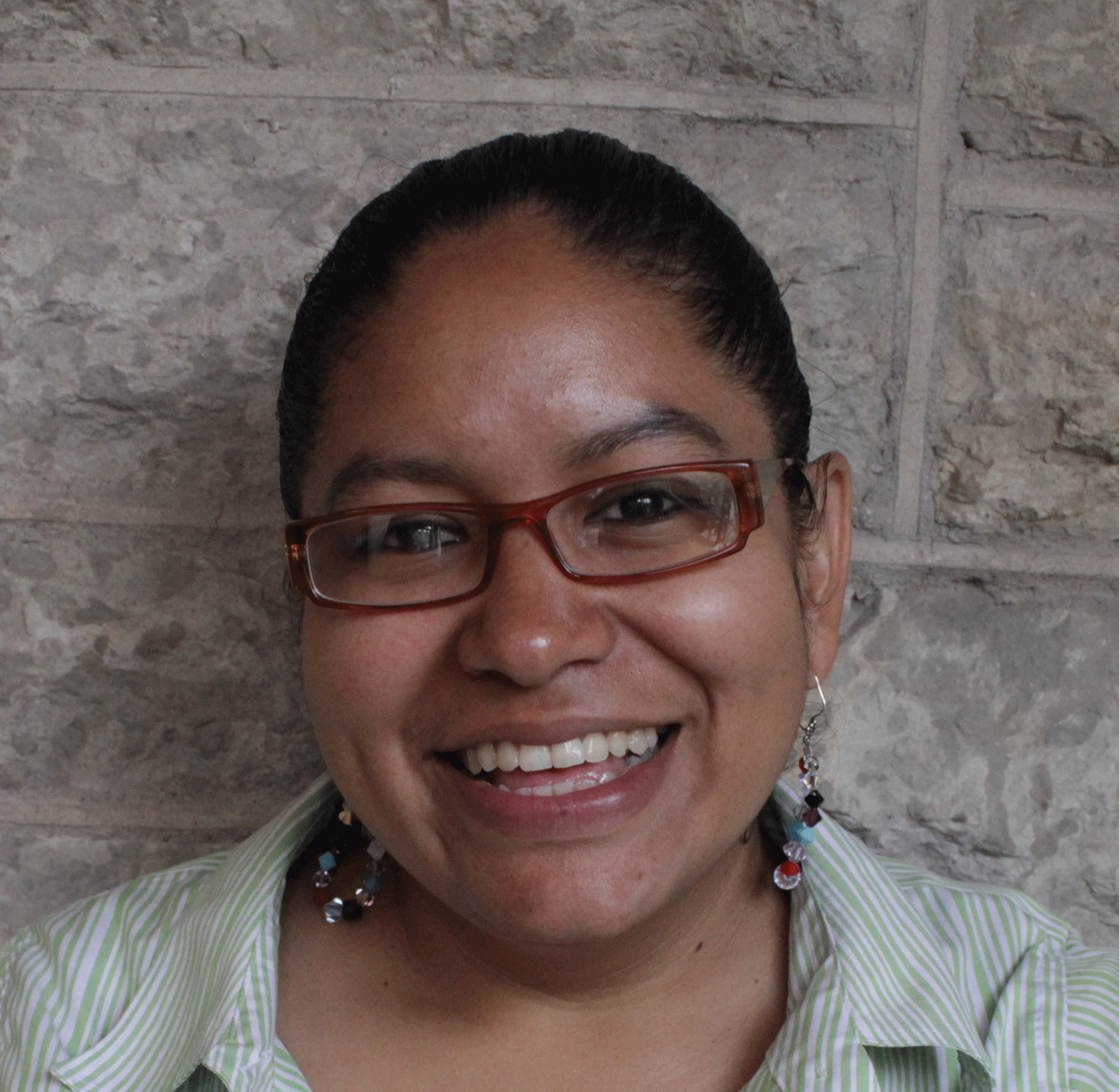
CSOP Participant Profile – Leda Garcia

by Ellen Paulley

Canadian School of Peacebuilding equips student with tools to work in restorative justice

Leda Garcia says her time at the Canadian School of Peacebuilding (CSOP) equipped her with the tools and knowledge to work effectively in the field of restorative justice.

An institute of Canadian Mennonite University, CSOP is a community of diverse peacebuilders who come together to learn, network, and engage in peacebuilding.

Prior to attending CSOP, Garcia says she had some knowledge of restorative justice, but wasn’t sure of “how to put everything together.” After taking the course “Restorative Justice with Youth and Schools,” Garcia says, “Now I have the tools and I know how to use them.”

Garcia intends to use her restorative justice knowledge in her work at home in Honduras. Working with the Mennonite church, Garcia has been involved in mediation and peace programs in schools.

“We’re trying to tell the kids they don’t have to go through life with a gun, beating people up to make a living,” she says.

Garcia has also worked with a friend to establish a mediation program in the school her friend’s children attended, in response to a wave of violence that was occurring in the school.

She’s passionate about working with youth and encourages them that they don’t have to be involved in a life of violence. “They can change, there is an opportunity,” she says. “They have to work hard but they can make it out.”

Growing up, Garcia didn’t have a strong relationship with her parents and says she had role models who “weren’t the right ones.” As a youth, she says she heard God’s voice call her and felt that she needed to find peace within herself.

“To make peace around you, and to find peace, you have to make peace with yourself; find that forgiveness place,” she says.

Garcia spent one year in Canada as part of Mennonite Central Committee’s International Volunteer Exchange Program. She says she wanted to visit Canada to experience being in a place where there’s “peace all around.”

She was also interested in learning about how concepts of justice vary from place to place. “Justice is always related to the culture, to the community,” she says. “What is justice to you could probably be security and welfare. For us, it could be as simple as having clothing or food for one year.” Once basic needs are met, it’s then possible to pursue other types of justice, says Garcia.

Prior to coming to Canada, she was studying ecotourism in university. But she says her time at CSOP assured her that’s not her path. “My way will be community development,” she says. “I know that feels better in my heart.”

Garcia’s advice to those who are considering coming to CSOP is to not be afraid of stepping outside of their comfort zone and to be open to growing and changing.

“I’ve grown more in this time than I’ve grown in my entire life, in ways that I didn’t know I needed to grow,” she says.
Categories
News Profiles

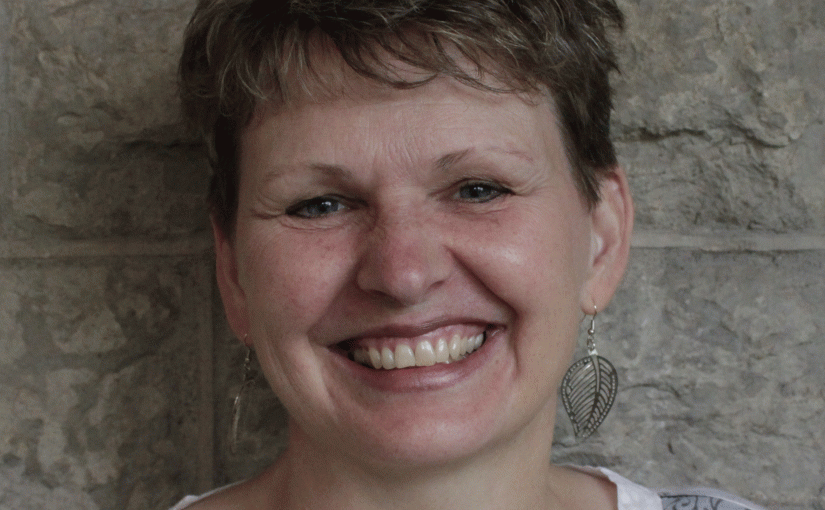
CSOP Participant Profile – Terry Schalm

by Ellen Paulley

Peacebuilding: Beyond Dealing With War

Terry Schalm, wife of a Lieutenant Colonel in the Royal Canadian Air Force, has learned alternative models of peacemaking while studying at the Canadian School of Peacebuilding (CSOP).

Schalm says that the approaches she’s learned at CSOP have been eye opening and that she’s learned “there are different ways of doing things without using force.” An institute of Canadian Mennonite University, CSOP is a community of diverse peacebuilders who come together to learn, network and engage in peacebuilding.

Schalm, who is also a student at CMU, says her education at CSOP and CMU has expanded her understanding of peacebuilding. “It’s not just preventing violence,” she says. “Peacebuilding is so much more than dealing with war. It’s building communities, building harmony, and seeing value and dignity in everyone.”

While Schalm says she finds value and truth in nonviolent peacebuilding, she says she hasn’t “been converted over yet.” She grapples with whether nonviolent action could be sufficient to “deal with leaderships and attitudes in some countries.”

She also ponders what changes would be required in order for nonviolent peacebuilding to become the norm. She says it will likely take the intentional efforts and substantial cooperation of many people for the world to move in the direction of peacebuilding and wonders whether “we’re committed to continue in a military fashion with our western thinking.”

But the idea that peacebuilding occurs at the local and individual level gives Schalm hope – “it all starts with individuals and moving toward [peacebuilding] and facilitating that growth over time.” She says her time at CSOP has taught her that even actions like compassionate listening can bring about peace.

Hearing other perspectives was a highlight of the CSOP class Schalm took this year, “Strategies for Trauma Awareness and Resilience,” taught by Elaine Zook Barge. “It was really helpful to hear what life is really like for those who have experienced trauma, not just what we imagine or hear in the media,” says Schalm.

In the future, Schalm would like to work in the area of mediation and says what she’s learned during this course will be very applicable. Through her time at CSOP, she’s grown in her awareness that “each person comes with a story and that each person should be entitled to voice their story with respect.”

Because of her husband’s 38 years of service with the RCAF, Schalm says she wasn’t initially sure if she’d be welcomed at CSOP, but comments that the diverse makeup of the School means that everyone is given a voice and is validated. “Instructors seem open to sharing their stories and lives with you and likewise are willing to listen to your story,” she says.

Schalm’s looking forward to talking with her husband about the concepts and approaches she’s learned. And while she might not yet be “converted,” her time at CSOP has “softened my attitude that the military way is the only way,” she says. “Maybe there is hope for people in leadership—that their hearts can be softened too.”


Categories
News Profiles

CSOP Participant Profile – Enole & Wazha Ditsheko and Keseopile Gaselebalwe

by Aaron Epp

Canadian School of Peacebuilding helps Botswana church leaders work for peace

When Enole and Wazha Ditsheko wanted to start a peace centre in their hometown of Gaborone, Botswana, they thought studying at the Canadian School of Peacebuilding at Canadian Mennonite University would help.

So, the Ditshekos travelled from the capital city in the Southern Africa country to Winnipeg this past June to participate. The Ditshekos helped start their church, New Temple of the New Jerusalem, five years ago, and are leaders in that church today. They came to Winnipeg with Keseopile Gaselebalwe, who works with young people that their church helps.

Enole says New Temple of the New Jerusalem is a church that resulted out of conflict. The leaders of his former church were corrupt, leading promiscuous lifestyles and not being open about how they were spending money that parishioners were giving the church. They were not willing to be held accountable — financially, morally or otherwise, Enole says.

“African churches are made up predominantly of poor people,” he explains. “If they are going to put money in the basket, they should be able to ask at a general meeting, Where did that money go?”

The matter was brought to the courts, but the congregation and its leadership were not able to reconcile their differences.

“(The leaders) knew if they gave answers, they would be exposed,” Wazha says.

That conflict showed the Ditshekos that Gaborone could benefit from a peace centre — a place where people could learn practical skills for resolving conflicts without using violence.

In addition to conflicts caused by corrupt church leadership, the Ditshekos say a challenge facing Christians in Botswana is the influx of people from Zimbabwe who have come to Botswana to escape the harsh living conditions in their homeland.

“As local people, we often feel they have taken over,” Enole says. “But these people are desperate and want to make a living.”

The peace centre would help these Zimbabweans adjust to life in Botswana and aid them in getting the proper documentation they need to live and work in the country.

New Temple of the New Jerusalem also currently works with 30 youth between the ages of 10 and 19 who come from difficult home lives because they have lost one or both of their parents to HIV/AIDS. These youth struggle to maintain healthy relationships and get a proper education because they have no positive role models and live in poverty. Drug abuse amongst this group is rampant.

Gaselebalwe and her colleagues already work with these youth, bringing them to the church each weekend where they attend services, sing in a gospel choir and receive a meal. Within six months of connecting with the church, many of these youth have gone from living on the streets to living at home with their grandparents. Most are back in school after having dropped out.

“We find ourselves having to build the blocks of morality for them,” Enole says. “To do that, we feel a peace centre will be very helpful.”

Enole, Wazha and Keseophile’s visit to the CSOP this past June was two years in the making. They worked together with their local church, along with a Mennonite church in Kansas and a Mennonite church in Winnipeg to work out visas, finances and accommodations to make the trip possible.

Enole says that taking classes at CSOP was important to the group, and with any luck, he and other people from his church will be back in 2015.

“For as long as the CSOP is running, we want to send people here,” he says. “That is my desire. That is my dream.”

Categories
News Profiles

CSOP Participant Profile – John Fox

by Aaron Epp

Criminal, prosecutor reunite at Canadian School of Peacebuilding

John Fox and Rupert Ross are used to seeing each other in the courtroom, not the classroom.

When Ross worked as the Assistant Crown Attorney for the District of Kenora, Fox encountered him during numerous bail hearings after being arrested for a variety of crimes, including assault and weapons charges.

“He was the enemy,” says Fox, 43. “It was always us against them.”

The two reunited at the 2014 Canadian School of Peacebuilding (CSOP), this time on friendlier terms: Fox enrolled in Exploring Indigenous Justice and Healing, a course taught by Ross.

Between 1992 and 1995, Ross was seconded to the federal Aboriginal Justice Directorate. He travelled across Canada, examining Aboriginal approaches to justice with special emphasis on healing programs for victims, offenders, families, and communities.

He wrote two books as a result: Dancing with a Ghost: Exploring Indian Reality and Return to the Teachings: Exploring Aboriginal Justice.

Fox discovered the books as a student at Menno Simons College (MSC).

“I loved his books,” Fox said, adding that reading them gave him a better understanding of his Aboriginal heritage, the gap in communication between Aboriginal peoples and the dominant white Canadian society, and the history of violence in his family.

“I was hurt a lot as a child,” Fox said. “Because of that hurt, if you don’t deal with it properly, you tend to hurt other people.”

Fox grew up in Big Trout Lake First Nation, a fly-in community in northwestern Ontario. From the age of 11 to 15, he was sexually abused. He lost two close friends to suicide as a teenager, and turned to drugs and alcohol to deal with the pain.

Until a few years ago, he had spent most of his life working as a drug dealer. Fox was a violent person whose run-ins with the law led to nine or 10 stints in jail.

In 2008, his then-girlfriend’s sister committed suicide in front of him. Blaming Fox, the woman’s brother and boyfriend burned down his house.

After the suicide, things began to change for Fox. He stopped dealing drugs and started attending Alcoholics Anonymous. He began volunteering at a church drop-in centre and embarked on a healing journey that has relied heavily on traditional Aboriginal practices.

Today, Fox has been sober for four years and he is happily married.

Reuniting with Ross at the CSOP was a pleasure for Fox, and an indication of how far he has come.

“He’s such a storyteller,” Fox said of Ross. “He reminds me of an elder. Ask him a question and he doesn’t answer, he tells you a story.”

Fox may be enrolled in Conflict Resolution classes at MSC, but he says that what he’s really studying is the man he sees when he looks in the mirror.

“I’m studying myself, because I was a person with so much conflict.”


Categories
News Profiles

CSOP Participant Profile – Lorne Brandt

by Aaron Epp

Course helps B.C. man promote reconciliation between indigenous and non-indigenous Canadians.

When the Truth and Reconciliation Commission (TRC) of Canada announced it would hold one of its national events in Vancouver, Lorne Brandt wanted to make sure he was prepared.

Part of that preparation involved taking a course titled “Covenants of Peace and Justice” at the 2011 Canadian School of Peacebuilding.

“I realized that in my background, both growing up and [through] many years training and professionally, I have been blessed by First Nations neighbours, teachers, friends, co-workers and patients,” says Brandt, a retired psychiatrist living in Richmond, B.C.

“I reasoned that this was surely preparation for something that I could do to promote reconciliation between these two groups of Canadians … As a follower of Jesus, I would have to also say that I believe His spirit has also been guiding me on this good way.”

Taught by Rev. Stan McKay, an Aboriginal educator who was Canada’s first Aboriginal Moderator of the United Church of Canada, “Covenants of Peace and Justice” introduced a Cree Christian perspective on living in covenant relationships.

With an eye on exploring the role of peacemakers in a global context, McKay and his students examined biblical covenants, historic First Nations treaties, and contemporary struggles for justice during the weeklong course.

Learning more about the background of how treaties shaped the interaction between First Nations peoples and European settlers left a lasting impression on Brandt, who over the past few years has had a desire to connect with First Nations peoples in his area as well as make others – particularly Mennonites – more aware of indigenous issues.

Our ancestors came to this land not appreciating the worldview of its indigenous inhabitants, Brandt says – an inclusive worldview that allowed Europeans to settle here and share in the bounty of the land.

“And what have we done?” Brandt asks. “We’ve taken [the land] and left it worse off. There’s a big injustice there we need to look at, repent of, and try to correct.”

Since attending the CSOP, Brandt has arranged for First Nations guests to come speak to his congregation, Peace Mennonite Church, as well as teach in the church’s adult education hour.

He has also made connections with Hummingbird Ministries, a local organization that has grown out of the Presbyterian Church. Brandt and his wife have attended a number of their sessions and promoted their work in bringing together a variety of First Nations Christians and non-First Nations.

In his role as deacon at Peace Mennonite, Brandt arranged for Hummingbird Ministries to hold its third annual Peace Through the Arts Festival at Peace Mennonite in November 2012.

“I even got to perform some of the songs that I had written back in the 1970s when I was living in the community of South Indian Lake in northern Manitoba,” Brandt says.

Brandt also volunteered at the TRC gathering in Vancouver, and led two discussions in his church’s adult education hour: the first on why Christians should care about the injustices done to First Nations, and the second on what Christians can do about it.

“I do have to say that my attendance at the Canadian School of Peacebuilding played a large role in my going down this path,” Brandt says. “That period of time sent my mind in several directions with respect to the whole issue of our relationship as non-indigenous Canadians with our First Nations Canadian fellow-citizens.”

“I would like to attend further Canadian School of Peacebuilding sessions as well,” he adds. “If one is prepared, they are an excellent means of stirring one to action.”


Categories
News Profiles

CSOP Participant Profile – Marissa Rykiss

by Aaron Epp

‘I’m really grateful … It was a very inspiring time in my life,’ says Marissa Rykiss

For Marissa Rykiss, attending the Canadian School of Peacebuilding was nothing short of life changing.

The 22-year-old Winnipegger enrolled in the course “Women and Peacebuilding” at the 2012 CSOP as part of a B.A. program in Conflict Resolution Studies at Menno Simons College.

Inspired by her mother, who practices collaborative law, Rykiss wanted to pursue a career as an immigration lawyer in order to make a difference in the world by helping vulnerable people.

After finishing the course, Rykiss realized she wanted to help people in a different way. Now, she plans to pursue a Master of Arts degree in Family Therapy.

First though, Rykiss is becoming a certified yoga instructor. She wants to teach yoga and potentially open her own studio.

Rykiss says her interest in teaching yoga stems from her desire to help people develop their self care so that they can be better people and lead more compassionate, empathetic lives.

“After taking [the CSOP] course, I realized there’s so many other ways I can help people, and I don’t necessarily need to have a title like lawyer to do that,” she says. “My happiness, and the happiness of others, is more important to me than having a title like that.”

Ouyporn Khuankaew, a Buddhist feminist peace trainer from Thailand, and Anna Snyder, associate professor of conflict resolution studies at Menno Simons College, taught the course.

Rykiss says it was the way the course was taught that impacted her so greatly.

“Ouyporn had a non-traditional way of teaching where she offered guided meditation at the beginning of each day, and it just allowed us to become a bit more mindful while we were present in the class,” Rykiss says. “She is one of the most inspiring and engaging women I’ve ever met.”

When the course ended, it was emotional for Rykiss.

“I cried on the last day and was so happy that I decided to participate in that particular course,” she says. “It felt like it was meant to be. It made me ask myself why I need to be pursuing something (a career in law) that isn’t consistent with who I am, and helped me understand that where I need to be is in a more transformative pathway—helping people who can’t help themselves get to a place of awareness and mindfulness.

“It wasn’t intended in the curriculum, but that’s just what I got out of it. A lot of people who participated were put off originally by this new way of thinking, but by the end, everyone there had experienced profound change in the way they thought about learning.”

Rykiss’s experience in the course led her to pursue a practicum placement in Thailand with International Women’s Partnership for Peace and Justice (IWP), an organization Khuankaew co-founded.

Rykiss’s work in Thailand included helping with a weeklong workshop for women that IWP organized. Each day began with yoga. While Rykiss had practiced yoga before, it was during this week that she came to fully appreciate the healing nature of yoga therapy.

“I realized … how important it is for people to learn how to be better to themselves, to treat themselves better and come back to themselves through yoga and meditation,” she says.

The practicum and change in career direction would not have happened without Rykiss’s transformative experience at the CSOP.

“I’m really grateful that I was able to take a course where everything could be condensed into five days,” she says. “There are such a variety of courses [at CSOP], and [the organizers] go out of their way to find people to teach the courses who have first-hand experience with the material.

“It was a very inspiring time in my life.”

Categories
News Profiles

CSOP Participant Profile – David Caceres

by Aaron Epp

‘War is something that no one should live,’ says retired Peruvian colonel.

If anyone knows about the realities of war, it’s David Caceres.

Caceres, who calls Lima, Peru home, was a colonel in the Peruvian army and served his country during the 1980s and 1990s. Witnessing the atrocities of armed conflict during the Cenepa War, a 1995 border dispute between Ecuador and Peru, caused Caceres to reevaluate what he wanted to do with his life.

“War is something that no one should live,” says Caceres, who was in Winnipeg June 17-28, 2013 to study at Canadian Mennonite University’s (CMU) Canadian School of Peacebuilding (CSOP). “We should have to respect everyone’s life.”

After the Cenepa War, Caceres began working for the Peruvian army in a peacekeeping capacity. That led to a job at the United Nations, where Caceres worked for four years as a training officer. In that role, he developed military training materials for the UN’s Department of Peacekeeping Operations.

With a wide range of experiences in managing human resources, mediation, and conflict resolution at the international level, Caceres has facilitated seminars, workshops, courses, and training in Africa, Europe, Asia, America, and Latin America.

Caceres is currently the Lima District Manager for World Mediation Organization, where he consults and trains people in mediation and conflict resolution.

He is also in the process of developing the International Peace Studies Center of Peru  that will help enhance the capabilities of communities and government workers to deal with conflicts in Peru so that they can resolve them peacefully.

He studied at the CSOP in June because he wants to expand his knowledge of conflict resolution.

“If you feel like being a cook, you need to have a lot of recipes,” Caceres says, adding that the CSOP instructors he learned from have given him a variety of different recipes for, or ways to approach, resolving conflicts.

“I’m putting everything in my bag and I believe I’ll use the knowledge and experiences and relationships [I made at the CSOP] so that I can do my job … in the best way.”

Categories
Media Video

CSOP Participant Reflections

If you want to know more about the CSOP and what the CSOP experience offers, take a few minutes to watch this video of reflections from 2013 CSOP participants and instructors.

Categories
Audio Media

Hummingbird by Anna Eileen

Take a few minutes to listen to this beautiful song, written by Anna Eileen and inspired by her week at the CSOP in 2012.

Hummingbird

Singer/Songwriter: Anna Eileen
Mix Engineer: Jason Phillips
'Hummingbird, your wings are torched
from dropping water on the fire
It keeps blazing while you work
and the elephants close their eyes

I want to see
I want to breath
I want to be
the music that heals

Femme avec peur
Les yeux qui ne veulent pas lui voir
Ton enfant est innocent
des choses qu'ont causé la guere

Je veux voir
Je veux savoir
Nous devons avoir
la musique qui guerisse

Fear-ing flag-born child of christ
how you cover yourself with fear
you chase your siblings with guns
and forget that Jehovah lives here

I want to share
I want to spare
I want to dare
the music that heals

Butterfly, you lead me round
open my eyes to your world
you suffered much and suffer still
drenching your wings in our hurt

Though we are weak
We'll work for peace
We need to seek
the music that heals


Categories
News

CMU News Release about 2012 CSOP participant, Schadrack Mutabazi

December 5, 2012

CMU Student Schadrack Mutabazi Maintains Hope for Stability and Reconciliation in Africa’s Congo

Schadrack Mutabazi is a Canadian Mennonite University (CMU) student who is doing his best to concentrate on his studies and embrace his family’s new Canadian home. It’s an everyday challenge for him because even oceans can’t separate him from the trauma he’s faced in his lifetime – and the trauma that continues to plague his family and his country.

Mutabazi was born into the Banyamulenge minority tribe in the Democratic Republic of Congo – which is to say, he was born into persecution and violence. He lived for ten years in exile in Rwanda and five years as a refugee in Uganda, spending his life as the victim of xenophobic persecution and life threatening circumstances, witnessing unspeakable atrocities, and losing many loved ones along the way.

“I have lost many relatives – parents, uncles, brothers, cousins, colleagues, and friends – and I have narrowly escaped life threatening incidents myself. I grew up with no peace, no hope for stability,” he said.

While he’s been victimized, Mutabazi is anything but a victim. In Africa, he became an ordained pastor and founded the HOPU Organization to bring hope and peace to hurt and suffering people – both those who have been persecuted and the persecutors themselves. “Deep inside, we all have interest in finding reconciliation and forgiveness. Even the perpetrators don’t live in peace,” said Mutabazi. “HOPU uses music to repair and restore, building bridges between groups of people who have been fighting for their entire lives. We want to see reconciliation. And we will get there someday. But first, we focus on just getting people sitting in the same room together and finding some common ground – through music, poetry, and other cultural activities.”

This married father of six children has moved his family – including some of his siblings, for a total of eleven people – to Winnipeg in search of the peace and stability he’s been looking for his entire life. At CMU, he is studying Peace and Conflict Transformation Studies and he also attended CMU’s Canadian School of Peacebuilding this past summer. He hopes that advanced education will help him continue to lead his people in healing and restitution.

“One of the most important things I’ve learned during my time at CMU so far has been the power of love and forgiveness,” he said. “It sounds so simple, but I’ve discovered that you must go inward first to find love and healing so that you can help others to do the same. This truth has been profound in my life.”

His work has continued here in Winnipeg, through Shalom Christian Outreach and Heritage Outreach, and Mutabazi plans to use his degree to continue promoting peace, unity, and social justice as both a church and a community leader.

When asked about his home country and the atrocities that continue there today, Mutabazi – holding onto his innate strength and optimism – said, “I see great possibilities for peace and reconciliation in the Congo.”

“The complexity of the real situation has been unrecognized – or undermined – by the organizations that have been trying to help there,” Mutabazi explained, “but God knows what is happening in the Congo. From my experience, I know that with deep spiritual maturity, we can remain positive and learn the process that can support resolution.”

“I am one of many who have experienced this extremely challenging journey,” he said. “What has happened in my life – the killing, the fear – surpasses all human understanding. But we can still preach the message of peace, love, and justice. God promises us, in John 14:27, a ‘peace that the world cannot give.’ Peace comes from God, and God has a wonderful plan for the Congo.”

This past week, increased tensions in the eastern Congo have sent some of the remaining members of Mutabazi’s family fleeing for their lives. Some are safe for now, but have been separated from their families and fears run high. Mutabazi is looking for ways to bring more of his family into Canada.

Article written by Lindsay Wright for CMU.