Categories
News Profiles

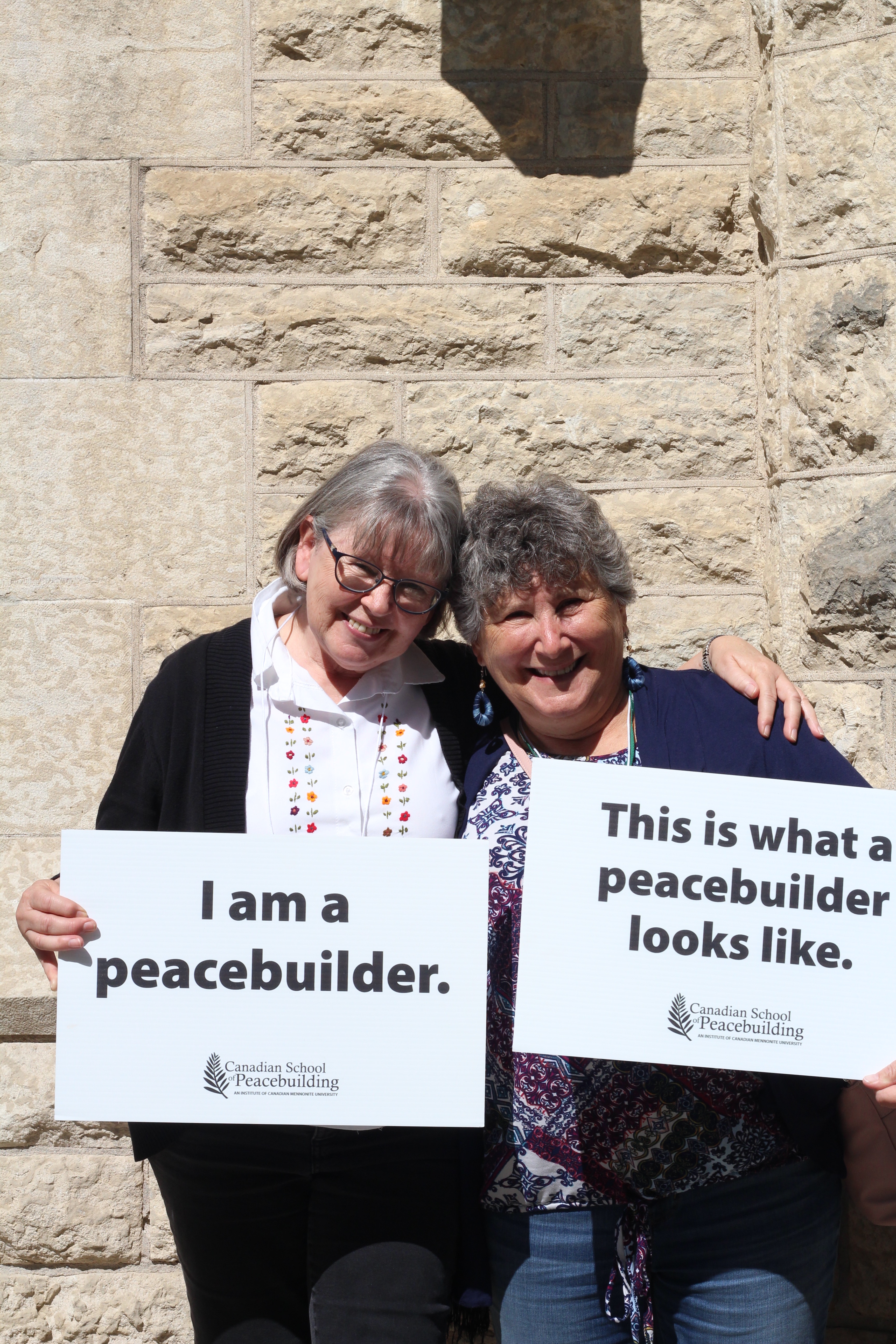
CSOP Participant Profile – Brooke Nagle and Lenora Yarkie

By Nicolien Klassen-Wiebe

A community of change-makers

Connecting with peacebuilders at CSOP empowering and inspiring

Before Brooke Nagle and Lenora Yarkie were even finished their 2019 Canadian School of Peacebuilding (CSOP) courses, they had already chosen their course for next year’s session.

“This is our third year at CSOP,” says Nagle. “I’ve gotten a lot out of these courses. I find they’re really thought provoking and useful in the volunteer work that I do.”

The two women met in El Salvador while volunteering as election observers for the presidential election in 2014. Yarkie, 69, from Alberta, was doing human rights work on Canadian mining in El Salvador with the United Church of Canada. Nagle, 63, from California, was working in the country with the organization Center for Interchange and Solidarity, which runs schools, clean water projects, and provides scholarships for students.

Now, years later, CSOP is an opportunity for the friends to reconnect every year. Although they keep in touch and sometimes see each other at the border of Arizona and Mexico, where they live with a group of Catholic nuns and do volunteer work with migrants, Yarkie says, “CSOP is a special time.”

This year, she took Peace Skills Practice with Natasha Mohammed, a community counsellor, mediator, and victim impact worker who has taught for almost two decades. Nagle took Making Music, War, and Peace with Dr. Svanibor Pettan, internationally renowned lecturer, researcher, and chair of the ethnomusicology program at the University of Ljubljana, Slovenia.

Not only is CSOP a chance to take fascinating courses and catch up with old friends; it’s also a place to form new relationships. “The ability to meet other students, both Canadian and international, who are struggling with some of the same issues in their own countries and hearing their experiences, I think this is huge,” says Yarkie.

Last year, Nagle and her husband travelled to Bangladesh after being invited by a Bangladeshi judge whom they had met at CSOP the previous year. “The people have been very interesting, very inspirational, from around the world. I find it a very impressive program,” she says.

Yarkie emphasizes how meaningful it is to meet people who are on the same page as you and who really understand what you’re talking about, even if you’ve never met before and are from opposite sides of the world.

“You always meet somebody here who is either interested in the international work you’re doing or who has done the same thing,” she says. Sometimes they’ve worked or visited more recently and can provide an update on the situation. “There’s a connection there and there’s a shared learning. This is what I really love.”

The way the world is these days, it’s comforting and empowering to be around people that can relate and are doing similar work, Nagle says. “There’s power in that sense of unity.” “You don’t feel like you’re alone in doing this sort of stuff,” Yarkie agrees.
Categories
News Profiles

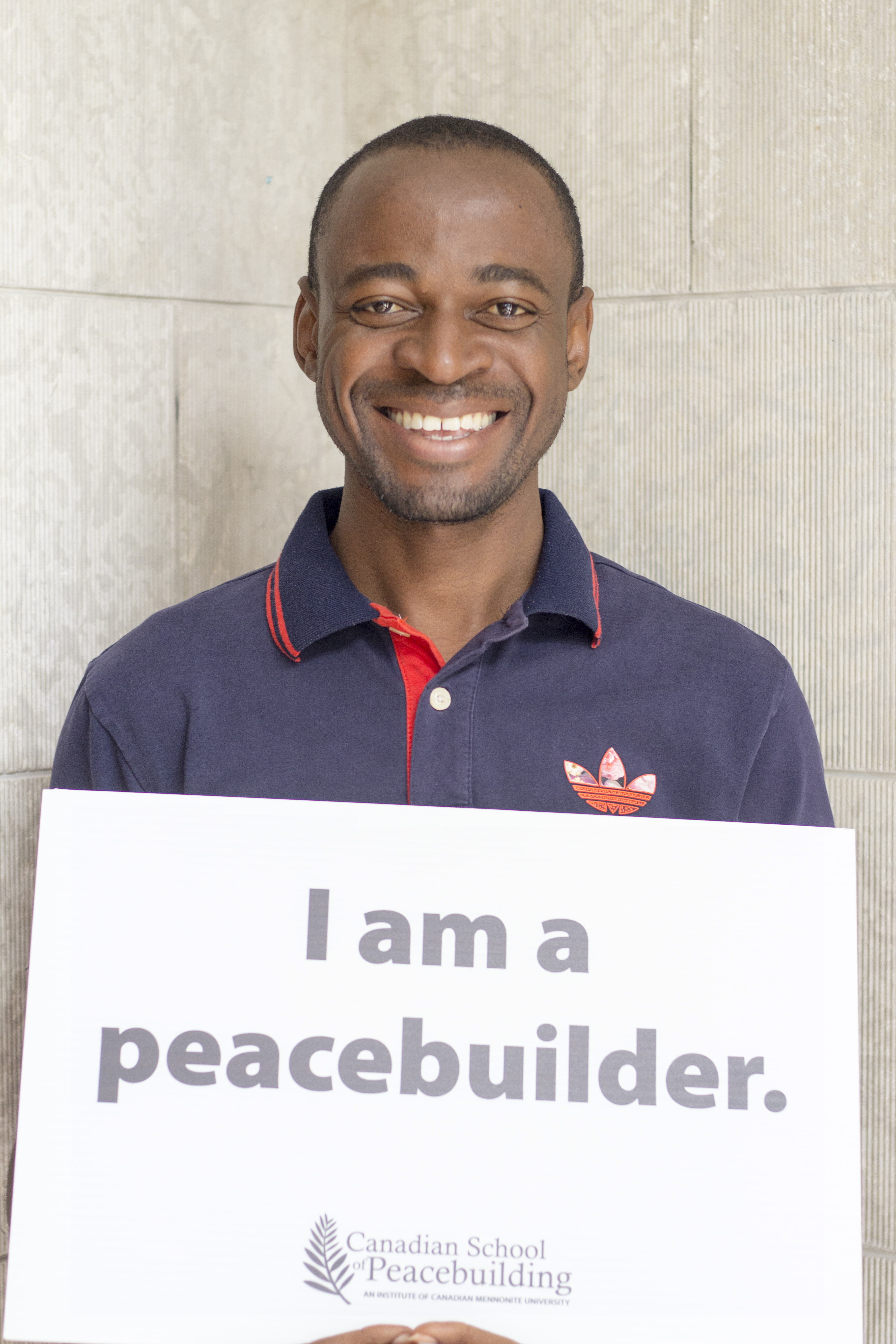
CSOP Participants Profile – Monday Adah Ogbe

By Nicolien Klassen-Wiebe

CSOP inspires Nigerian peacebuilder to reconnect and reflect

It was when Monday Adah Ogbe left his home country and flew across the ocean to attend the 2018 Canadian School of Peacebuilding (CSOP) that he connected with his roots.

Ogbe, 41, is a minister in a Catholic church in Nigeria and works with the non-governmental organization Pax Amor Initiative, which provides clothing and other material resources, health education, gender violence education, and conflict resolution in rural communities in northern Nigeria.

Recently, though, he asked for some time off to reflect on his life and get refreshed. He stumbled across the CSOP while doing a Google search for master’s programs and it quickly became part of his plan. “I just felt I needed peace building,” he says.

Peace has been an ongoing struggle in Ogbe’s life. As a Christian living in a Muslim area of Nigeria, he grew up amidst a lot of conflict. He and his family were attacked and had to flee twice because of Boko Haram, a jihadist terrorist organization. But it’s not just Boko Haram that is the problem. Religious clashes between Christians and Muslims happen time and time again, sometimes just starting from small issues. He says you never know when something little will turn into a crisis.

People are stuck in a cycle of trauma, but Ogbe says they don’t have resources in their community to help them deal with it. “Sometimes I think the church is the only resource where you go, you are consoled, you speak to somebody, you are prayed for. That is the only resource we have for healing trauma,” he says.

That’s why his CSOP class “Trauma, Peacebuilding, and Resilience – Level 1” with Vicki Enns, Clinical Director of the Crisis & Trauma Resource Institute, and Wendy Kroeker, Assistant Professor of Peace and Conflict Transformation Studies at CMU, was so meaningful. “I feel it’s going to be very relevant and useful for me,” he says.

Ogbe also took “Conflict and Development Issues in Indigenous Communities” with Tabitha Martens, an Indigenous rights activist and PhD student studying Indigenous Food Sovereignty. He says he’s going home with a new understanding of his own Indigenous roots and motivation to connect with his roots, where he finds his identity.

He says CSOP’s welcoming atmosphere of openness makes it easy to build friendships. “It was very profound, very deep,” he says. “If I had the opportunity, I’d take all the CSOP courses.”

Ogbe is currently studying for a Master of Arts in International Development Studies at Saint Mary’s University in Halifax, NS.


Categories
News Profiles

CSOP Participant Profile – Lisa-Marie Hasiuk

By Jonathan Dyck

The CSOP Grows Community of Peacebuilders

“There are not a lot of opportunities like this in the world, where you can have people from all over the world who are all passionate about the same thing,” says Lisa-Marie Hasiuk. Like a lot of students at the Canadian School of Peacebuilding (CSOP), Hasiuk loves the community and the passion for peacebuilding that CSOP, now in its 11th year, brings.

A university student, Hasiuk is an International Development Studies major and has been studying for the last 11 years, due to switching majors. She first heard about CSOP three years ago and was excited to complete her first week of studies with CSOP just this past June.

CSOP sparked a passion for social justice in Hasiuk that she never knew she had. Specifically, it was the course titled “Who is my Neighbor? Ethics in a Bordered World”—taught by Roger Epp, Professor of Political Science at the University of Alberta—that had the biggest impact.

In the future, Hasiuk plans to work one-on-one with people in Indigenous communities. “I think that's where a lot of work needs to happen as opposed to policy change and it has to start at the grass roots,” she says.

She is planning for her future practicum with two people, Michael and Judie Bopp, that she met through the CSOP. “They're people who have done it all. They're doing a lot of work in Indigenous communities and I want to become involved.” Had it not been for the CSOP program, Hasiuk would not have discovered her passion for social justice, nor would she have met the Bopps and thus developed a network through which to pursue her calling to work with Indigenous communities.

Categories
News Profiles

CSOP Participant Profile – Carol McNaughton

by Nicolien Klassen-Wiebe

Peacebuilding across borders

Travel inspires young peacebuilder to attend the CSOP

Carol McNaughton spent a semester in South Africa with Outtatown, Canadian Mennonite University’s (CMU) discipleship program, and has dedicated herself to peacebuilding ever since.

“I did Outtatown right after high school and that kind of sucked me into the Mennonite world I would say.” She began working at Camp Valaqua, a Mennonite camp in Alberta, and participated in Mennonite Central Committee (MCC) programs like Serving and Learning Together, where she spent a year in Cambodia. The 25-year-old now works full-time as the Peace Program Coordinator at MCC Alberta.

It was on Outtatown that McNaughton first heard about the Canadian School of Peacebuilding (CSOP). She took a course shortly afterwards and enjoyed it so much that she returned for more.

This past June she took the CSOP class “Who is my Neighbour? Ethics in a Bordered World” with Roger Epp, Professor of Political Science at the University of Alberta. “I’ve really enjoyed it,” she says. She’s excited to dig further into what they discussed, like the question of who your neighbour is and how to approach ethics if everyone is your neighbour, not just the person who lives next door.

“I chose this course because it felt like it was more out of my comfort zone in some ways … this one was more new to me,” says McNaughton, who has a degree from the University of Calgary in Social Work with a minor in Dance. It was also the themes of neighbours and borders that drew her to the course, as her trip to Israel Palestine two weeks earlier on an MCC learning tour had left the image of the wall cutting through Israel Palestine sharp in her memory.

McNaughton had visited once before, but as a tourist. “I spent most of my time in Israel, [I] hadn’t been to Palestine really,” she says. “It was intense both physically and emotionally to hear those stories but also energizing and inspiring to hear directly from people who are working toward peace and justice.”

A lot of things from the CSOP will stay with McNaughton, but one sticks out in particular. “People at CSOP come from all over the world. That is really the amazing thing about CSOP, is you meet up in a classroom with those different perspectives,” she says.

“Just having that inspiration of having a community of peacebuilders that, even when it doesn’t seem practical in some ways, are still committed that we have to keep caring and we have to keep working through these things to best love our neighbours.”

Categories
News Profiles

CSOP Participant Profile – Andrea De Avila

by Jonathan Dyck

From Mexico to America to Canada: Trauma and Pastoring

“I found out about CSOP (Canadian School of Peacebuilding) through CMU (Canadian Mennonite University) and everyone I knew. They all said it was a great program,” Andrea De Avila says.

Andrea De Avila’s life story begins in Mexico. “I grew up as a Quaker and was only one in a thousand Quakers in Mexico. The faith and tradition that was passed down to me has meant a lot to me.”

“Our family moved to another city closer to the Mexican border, where we tried out multiple different churches and finally my dad discovered a Mennonite church,” she says. “He only knew Mennonites as people who ‘sold cheese’ at that point.”

This was De Avila’s first connection to the Mennonite community. Later she attended Eastern Mennonite University (EMU) in Virginia, got married, and moved to Winnipeg.

De Avila, 27 years old, is now the Associate Pastor at Sargent Mennonite Church in Winnipeg. “My reason for joining CSOP was to learn from different profs and to immerse myself in the world of peacebuilding,” she says. She feels the class she took at the 2018 CSOP—Trauma, Peacebuilding, and Resilience – Level 1— is relevant to her work. “As a pastor, people trust you, and because of that a lot of people tell you their stories of trauma and resilience.”

De Avila feels it is crucial to learn about peacebuilding and help people through trauma they experience through witnessing violence. This is exactly what Vicki Enns, Clinical Director of the Crisis & Trauma Resource Institute, and Wendy Kroeker, Assistant Professor of Peace and Conflict Transformation Studies at CMU, equipped students to do in their class. “I learned very practical ways of grappling with trauma and finding a centering point,” says De Avila.

In her class, De Avila talked about the conflicts behind the United States election and how it related to peacebuilding. “Something that I reflected on in class was that there were two different ways of interpreting the last U.S. election. Something important to know about the CSOP program is that they do not have any biases on anything. When they discuss the 2016 election, they do not do it with an “anti-Trump” agenda … but rather they examine both sides and try to rationalize why people support Trump.” “On one hand there is hearing people's fears, and on the other hand, there was inviting people to listen to that discontent.” CSOP is very informative in terms of understanding why the world is the way it is and presenting it in a way that doesn’t have any biases.

What Andrea learned through her CSOP studies will always be important to her, not just in her work as a pastor, but also in her understanding of the world around her.

Categories
News Profiles

CSOP Participant Profile – Iryna Dehtiarova

by Alison Ralph

CSOP gives Ukrainian peacebuilder tools to help those affected by war

Conflict in Ukraine led Iryna Dehtiarova to the 2017 Canadian School of Peacebuilding (CSOP).

“The war started three years ago, and people have experienced so much trauma,” says Dehtiarova, who works as a project coordinator for health, education and now peace projects, with Mennonite Central Committee (MCC) in Zaporizhzhia, Ukraine.

“It was surreal. These things happen in other parts of the world, but not here.”

MCC’s response in the Ukraine began with humanitarian aid. Four years on, Dehtiarova and her colleagues have seen the need for psychological support, trauma healing, and peacebuilding.

“A lot of internally displaced people have come to Zaporizhzhia and they are traumatized by the experience,” says Dehtiarova. “We have veterans who are returning, and we want to support them, but we have no idea how to respond.”

Some of Dehtiarova’s colleagues have studied at the CSOP over the years, so when her supervisors approached her about the possibility of coming herself, she was excited.

Dehtiarova says the CSOP is giving her the practical tools she needs to help people in her home community.

In her first week at the CSOP, she took Expressive Trauma Integration: Caregiving and Conflict Transformation with Dr. Odelya Gertel Kraybill, a leading trauma therapist, researcher, and consultant, with experience as a trainer with the UN in the Philippines, South Korea, China, and Japan.

“It relates so well to my context,” says Dehtiarova, recalling a woman in her church who hid when the New Year’s fireworks went off. The noise and flashes of light triggered the trauma she had experienced in the conflict zone.

“Without these courses I wouldn’t have understood her reaction,” Dehtiarova says. “Now I understand not only the emotional response, but also the physical response in the body and the brain, and I can help people to overcome that through art, and creative exercises.”

In her second week at the CSOP, she took Practices for Transforming the Peacebuilder, with Dr. Ron Kraybill, a peacebuilding consultant with over 30 years of experience, including most recently six years as Senior Advisor on Peacebuilding and Development for the UN in Lesotho and the Philippines.

 “People have been vulnerable and I value that,” says Dehtiarova. “To learn from other peoples’ personal experiences is powerful.”

Categories
News Profiles

CSOP Participant Profile – Rudy Friesen

by Alison Ralph

Tutoring newcomer youth inspires retired teacher to come to the CSOP

At 81 years old, Rudy Friesen may be the oldest participant at the 2017 Canadian School of Peacebuilding (CSOP).

“I don’t feel that I’m that much older in terms of ideas,” he says. “I think I’m still open to new insights, ideas, and stories.”

Friesen attends the same church as Valerie Smith, Co-Director of the CSOP, and says he’s had many opportunities to hear about it over the years.

“She told me I’d really enjoy [the CSOP], and after three years of her telling me this, I finally came.”

A retired teacher, Friesen volunteers his time tutoring recent immigrant and refugee youth at Grant Park High School in Winnipeg, MB.

“I work primarily with Muslim and Yazidi students,” says Friesen. “Because of that, I thought I need to learn something about interfaith dialogue. That was the deciding factor.”

At the CSOP, Friesen took Peace Resources in Islam and Christianity, taught by Dr. Mohammad Ali Shomali, founder of the International Institute for Islamic Studies in Qom, Iran, and Director of the Islamic Centre of England; and Dr. Harry Huebner, Professor Emeritus of Theology and Philosophy at Canadian Mennonite University.

“It’s a great experience,” says Friesen. “I’ve been to all kinds of conferences, but to get a group of well-educated people from all over the world—they’re bright, they’re sharp, they have experience and they have a passion for peace. To listen to them and engage with them in dialogue—it’s a very unique opportunity.”

“The age factor from my perspective has not stopped me or slowed me down or influenced others,” adds Friesen. “I sit back sometimes and admire how articulate some of the younger folks are in their theology.”

What he’s learned at the CSOP is very applicable to his work tutoring newcomer youth.

“I want to encourage them,” says Friesen, observing that the transition for these young people can be difficult.

“If we’re going to live together in community, we might as well understand each other.”

Categories
News Profiles

CSOP Participant Profile – Min-Goo Kang

by Alison Ralph

“We’re all peacebuilders,” Pastor learns at the CSOP

“I didn’t define myself as a peacebuilder, but I guess we’re all peacebuilders,” says Min Goo Kang.

That’s one of the most significant things he learned at the 2017 Canadian School of Peacebuilding (CSOP).

A minister at Fort Garry United Church in Winnipeg, Kang first came across the CSOP through a brochure.

“My wife and I have taken other workshops through CMU, and have had a great experience, so we look to CMU for new things.”

In his first week at the CSOP, Kang took Expressive Trauma Integration: Caregiving and Conflict Transformation with Dr. Odelya Gertel Kraybill, a leading trauma therapist, researcher, and consultant, with experience as a trainer with the UN in the Philippines, South Korea, China, and Japan.

“I’m interested in learning how to be sustainable, how to sustain myself,” says Kang. “Over the last six months I noticed how I’m affected by my family members, and what’s going on in the congregation. So, it’s critical to be able to access the resources I need to sustain myself, and care for my congregation.”

In his second week at the CSOP, Kang took Practices for Transforming the Peacebuilder, with Dr. Ron Kraybill, a peacebuilding consultant with over 30 years of experience, including most recently six years as Senior Advisor on Peacebuilding and Development for the UN in Lesotho and the Philippines.

“This was a course I needed at this time in my life,” says Kang. “It helped me to learn about myself in such a deep way, that wouldn’t have been possible on my own.”

Kang calls the CSOP “world class” and “exceptional.”

“The staff, and faculty—this is their vocation, it’s not just their job,” says Kang. “As soon as anyone walks into the building, they can feel that this is a safe place to be themselves.”

Originally from South Korea, Kang and his family moved to Canada in 2007 to pastor a church on Vancouver Island.

“I was working as a second minister in a church with 500 people in South Korea, but I felt something was missing,” says Kang. “That’s why I came to Canada.”

The language barrier was tough to overcome, he says, but he came to a place where he could express himself and understand others, not limited to the use of words.

In 2014, Kang’s wife got a call from The United Church in Meadowood in Winnipeg, and he followed.

“Home is when I’m in a place where I can communicate with the holy, with others, and with myself freely, and with authenticity,” says Kang. “I know I’m home now.”

Categories
News Profiles

CSOP Participant Profile – Fareeha Iftikar

by Alison Ralph

“It’s like home,” at the CSOP, says inter-faith peacebuilder from Pakistan

When Fareeha Iftikhar’s plane landed in Winnipeg last June, she says it felt like coming home.

Although she currently lives in Pakistan, Iftikhar was born in Abbotsford, BC. It was her desire to study at the Canadian School of Peacebuilding that brought her back to Canada.

Iftikhar was looking at professional development opportunities when she remembered meeting Wendy Kroeker, co-director of the CSOP, at the Mindanao Peacebuilding Institute in the Philippines, in 2015.

“We looked at the dates and courses and (the CSOP) fit,” says Iftikhar, who works on interfaith peacebuilding projects for Norwegian Church Aid (NGA).

Before joining NGA, Iftikhar worked for the Canadian High Commission in Pakistan.

When the government of Canada established the Office of Religious Freedom in 2013, she and her colleagues encouraged the High Commissioner to meet with leaders of different faiths.

“We did roundtables to bring together people from all walks of life for discussion and developed a network,” she says.

Those discussions highlighted some of the intra-faith and inter-faith challenges facing people in Pakistan. When Iftikhar joined NGA, she knew it was something she wanted to stay involved in.

“Often, it’s a case of people lacking information, and those small misunderstandings can lead to conflict,” she says. “But, people can always learn.”

This past year, Iftikhar produced and hosted a television show in Pakistan called Hum Aik Hain, which means, “We are one.”

The eight-episode series highlighted the contributions of people from diverse backgrounds and faith traditions in Pakistan.

“We had a lot of positive feedback from the community,” Iftikhar says. “It just shows that hard work always pays.”

 In her first week at the CSOP, she took Journalism and Peacebuilding with David Balzer, Assistant Professor of Communications and Media at Canadian Mennonite University. Iftikhar found the course very interesting, given her recent media experience.

“The question I wanted to answer was, how do we quickly and accurately gauge the success of a media project?” she says. “It takes time and repeat messaging to shift people’s thinking, and media is a visual tool with great potential for impact.”

In her second week at the CSOP, Iftikhar took Practices for Transforming the Peacebuilder with Dr. Ron Kraybill, a peacebuilding consultant with over 30 years of experience, including most recently six years as Senior Advisor on Peacebuilding and Development for the UN in Lesotho and the Philippines.

Overall, her experience was wonderful.

“As a Muslim traveling here during Ramadan, I wasn’t sure what it would be like,” Iftikhar says. “Would it be diverse and welcoming? And it is. It’s a diverse group of people from all over the world and they’ve been very welcoming. It’s like home.”

Categories
News Profiles

CSOP Participant Profile – Ashley Hayward

by Alison Ralph

Peacebuilder bridges gap between undergrad and master’s studies at the CSOP

Growing up Ashley Hayward was told that she could do anything. It was a positive message, but an overwhelming one as well, with enough options and opportunities to get lost in.

She knew she had to find something that fit with her values. That’s how she found herself at CMU’s Menno Simons College (MSC), majoring in Conflict Resolution Studies.

"From the very first course I took, I realized how applicable it was to my life and the further I went the more I realized how applicable it was to so many things beyond.”

As a working mother and a full-time student, Hayward also knows the value of practicality.

That’s what appealed to her about attending the 2017 Canadian School of Peacebuilding.

Hayward had just completed the Honours thesis for her undergraduate studies at MSC on how language shapes conflict and figured that studying at the CSOP would be a good bridge to her master’s training.

In her first week at the CSOP, Hayward took Journalism and Peacebuilding. She loved it.

“Communications theories are as important to relationships and to peacebuilding as the theory and practice of peacebuilding itself,” Hayward says “It’s critical.”

In her second week at the CSOP, Hayward—who is Métis—took Human Rights and Indigenous Legal Traditions.

She says she’s only just beginning to get to know her Indigenous heritage, and the course has helped her to do that.

Hayward adds that studying with people from a variety of backgrounds was a highlight of her CSOP experience.

“The international perspectives around the table and the actual experience from people around the world, from different walks of life, different parts of their careers, gave a different reference point for us,” she says.

Hayward is now a student in the Joint Master of Arts Program in Peace and Conflict Studies at the University of Manitoba and the University of Winnipeg.

She is the first person in her family to graduate from university.

“I’ve felt a lot of pressure, but I’ve felt a lot of support as well,” she says. “The coolest moment for me was to hear my six-year-old say, ‘My mum’s becoming a problem solver.’”

“It showed me that my kids are picking up on what I’m doing,” she adds. “They’re being impacted by what I’m learning, even if they don’t realize.”